
Why does ALEX ask about "current medical spending" in the Profile?
ALEX uses aggregate claims data to find patterns and recommend the best benefits package based on what's worked for "people like you."
Now, ALEX goes even further— bringing in personal claims data to help employees make an even more informed decision. All an employee has to do is input the information found on their insurance card. This is an optional question in the ALEX profile.
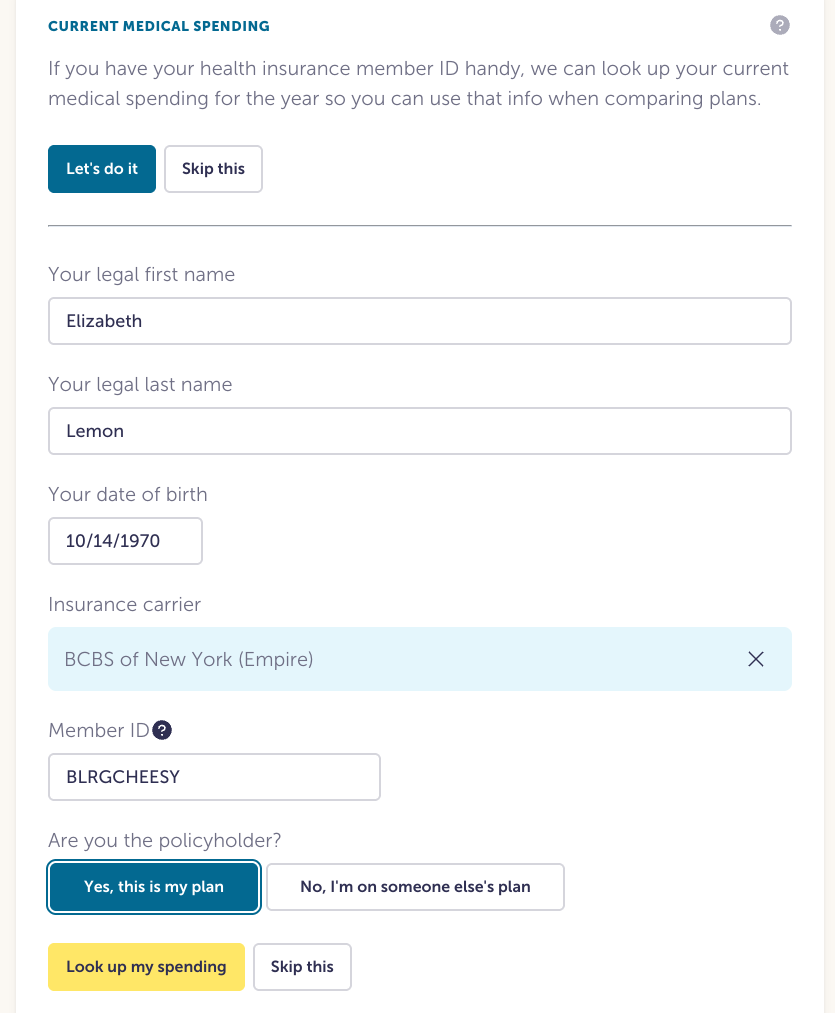
In the Profile, ALEX will offer users the option to provide key details about their current medical plan, including their legal first and last name, member ID, insurance carrier, and whether they are the policyholder. Using this information, ALEX will look up how much they’ve spent toward their deductible and out-of-pocket maximum.
Once a user is in Benefits Counselor or ALEX Go, they’ll see their spending details alongside ALEX’s plan recommendations to help them make informed choices. And in Benefits Counselor, ALEX also will display how much they’ve spent when explaining how a plan works.
How is this personalized claims information different from how ALEX currently uses other claims data?
ALEX will use this personal data to show users how they actually use their benefits. This is optional—each user can choose whether or not to provide their healthcare usage data.
This differs from how ALEX estimates future healthcare costs and makes its recommendations for each user based on large sets of anonymized claims data.
What information does the personalized claims tool show to users?
ALEX will show users who opt in the total spend on their current plan vs. their deductible and/or out-of-pocket maximum.
For users covering family members, that total spend won’t be broken down by each individual’s spend.
Where does ALEX show users their total spend?
ALEX provides users with their total spend on their current plan during several strategic moments where those points of comparison could help users make the best decision for their needs.
ALEX Benefits Counselor
During the medical plan comparison in the Medical Recommender, directly below the cost comparison bars.
During the high-level explanation of how each plan works in the Medical Explainer, directly below the cost arrow.
ALEX Go
On the main “Choose a Health Plan” screen, next to the high-level info for each plan.
I don't see our carrier on the personal claims form. How do I find it?
Some insurance carriers have different regional branding which can create some confusion in the ALEX profile's personal claims tool.
ALEX uses a standardized list of carrier names, so your entry might need to match what ALEX recognizes. If you encounter trouble finding your carrier, try searching for a shortened version of its name, like "BCBS of Illinois" instead of "BlueCross BlueShield of Illinois."
Do users have to answer personalized claims data questions?
No. Users can choose to skip it if they don’t want to provide the information.
How does personal claims data impact ALEX's recommendation?
Short answer: it doesn’t. ALEX will show this info to users who opt in so they can make informed decisions, but will not use it to calculate estimates or make recommendations.
How is Jellyvision storing and using personal claims information?
Jellyvision is SOC 2 certified and maintains strong internal controls and security practices to handle sensitive data.
Jellyvision stores ALEX user data in accordance with HIPAA rules and regulations to protect the privacy of users’ personal health information.
All user data is encrypted twice: the database storing ALEX user data is encrypted as a whole, as is each user record individually.
For more information, check out the Jellyvision Trust Center.